A memorable vanity number should survive a real customer interaction: a brief glance at a sign, a spoken recommendation, a small mobile screen, or an audio advertisement heard while doing something else. The goal is a complete phone number that people can understand, retain, and enter correctly. An attractive word is only the starting point.
Use a selection process that tests the whole experience. Begin with the customer's task, build a manageable shortlist, check the digit mapping, compare prefixes, and review current service options. Keep creative exploration separate from claims about availability. A phrase can be an excellent idea even when a particular matching number cannot be assigned to your business.
Write the job the number needs to do
Before brainstorming, describe where the number will appear and why someone would use it. A support line on product packaging needs to remain understandable for years. A service campaign may need a phrase that makes sense after one audio mention. A company with several product lines may need wording broad enough to remain useful as the business changes.
List three requirements and three preferences. Requirements might include clear pronunciation, an acceptable complete length, and compatibility with the intended campaign format. Preferences might include a brand word, a repeated digit, or a particular prefix. This separation helps the team avoid treating every early idea as a condition that must be met.
If you are still deciding what kind of number fits the business, review the vanity toll-free number planning overview before narrowing the word list.
Build word groups instead of one favorite
Create several small groups: brand words, service descriptions, customer outcomes, and simple numeric patterns. Use familiar language from customer conversations. Internal product abbreviations may mean little to someone seeing the business for the first time. A phrase that requires an explanation is a poor candidate for a short contact instruction.
Review each candidate for pronunciation and spelling. Ask whether a listener could hear a different word, whether the plural matters, and whether the phrase makes an unintended claim about service. Words suggesting immediate assistance or continuous availability should match the actual answering experience. A number that promises more than the team can deliver creates avoidable friction.
Keep approximately six serious candidates after the first review. That is enough to preserve alternatives while allowing each option to receive a useful test. Record why discarded ideas failed so the team does not repeatedly reopen the same debate.
Translate the word to digits independently
A phoneword represents a numeric sequence. On a standard telephone keypad, ABC map to 2, DEF to 3, GHI to 4, JKL to 5, MNO to 6, PQRS to 7, TUV to 8, and WXYZ to 9. For a straightforward toll-free display, work with the seven digits after the prefix and verify every character.
For illustration, the seven-letter word REPAIRS maps to 7372477. This is a word-mapping example, not a claim that any complete number containing those digits is available. Have one person prepare the mapping and another check it without copying the first person's work. Then compare the result against the exact number identified by the provider.
Somos describes how RespOrgs can search using digit patterns and keypad letter values in its TFNRegistry Number Administration documentation. A creative shortlist supplies search criteria; an authorized provider's current check establishes what can move to the next step.
Evaluate the complete prefix and ending together
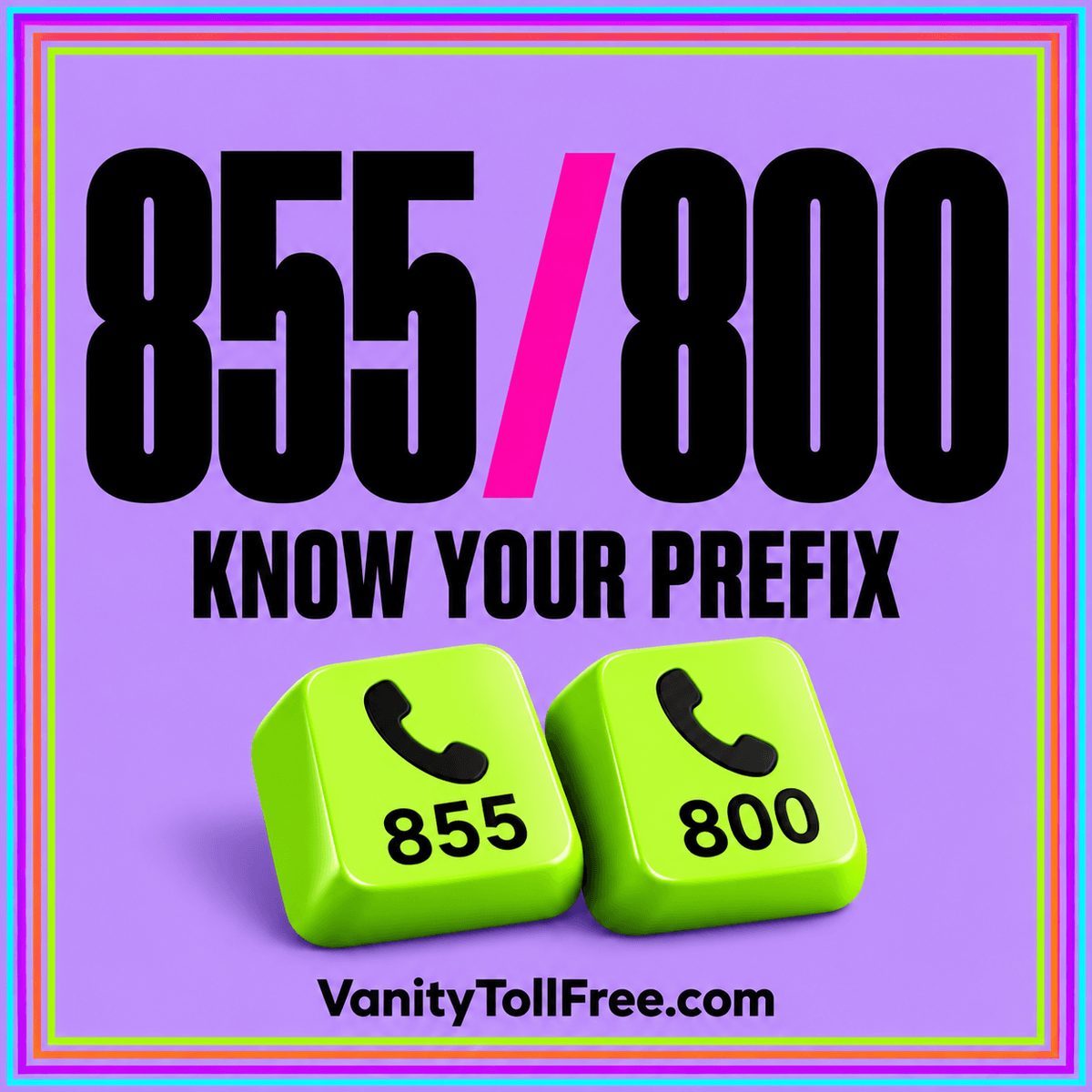
A word should never be evaluated without its proposed prefix. An 855 number is different from an 800 number with the same seven-digit ending. Customers need the complete combination to reach the intended destination. Do not rely on a listener to fill in a familiar prefix or assume every version of a phrase points to your business.
Compare each acceptable full display in the actual layout. Keep the prefix close to the phrase and give both enough space to remain legible. If the phrase must wrap on a narrow screen, make sure the relationship remains clear. For audio, test the rhythm of the complete instruction rather than repeating only the memorable word.
Our 855 versus 800 comparison explains how to weigh prefix clarity alongside customer testing and service terms.
Run a simple recall and dialing test
Recruit people who resemble the intended audience and have not helped create the shortlist. Show one candidate in context or read the proposed script at a natural pace. After a short unrelated task, ask them to write the complete number they remember. Next, ask them to enter its numeric version without help.
Use errors to refine the shortlist
Record errors separately. Someone may remember the word but miss the prefix, spell the word differently, reverse two digits, or hesitate over a letter. Those are different design problems. A larger type size might solve a visual issue, while a simpler word may be needed for a repeated listening mistake.
Use the results to improve the candidate and repeat the same test conditions. Avoid calling a small informal test proof of a universal conversion lift. It is a practical method for uncovering confusion before publication. Preserve the notes so later design changes can be checked against the original findings.
Test the formats customers will actually use
Prepare a small set of realistic mockups. Include the smallest mobile placement, the largest physical placement, and the shortest spoken version. A contact message that performs well on a desktop presentation may become difficult on a moving vehicle or a crowded receipt. Judge each version at an appropriate viewing distance and duration.
- For websites, show readable contact text and a matching telephone link.
- For print, check contrast, spacing, and the numeric version where practical.
- For audio, speak the prefix clearly and allow the number to finish without competing information.
- For staff scripts, use one approved pronunciation and one consistent display.
- For multilingual audiences, test the actual languages and accents involved.
Give design and marketing teams a single approved reference containing the phrase, prefix, digits, capitalization, and spoken wording. This reduces transcription mistakes when the number appears in new materials.
Check fit with the business and service arrangement
Ask whether the candidate still works if you add a product, expand a service area, or change the answering workflow. A narrow phrase can be effective for a defined campaign, but it may be awkward as the company's main contact identity. Record the intended lifespan and the places where replacement would be costly.
Review possible confusion with established brands and other contact information before making a commitment. Do not treat a successful numeric mapping as permission to use someone else's identity. Where a candidate raises a real rights question, resolve it before production rather than relying on the availability of a telephone number.
Also confirm the service relationship. A business ordinarily subscribes to toll-free service and receives an assignment administered through a RespOrg. Marketing language about buying a number should not imply unrestricted ownership or unrestricted resale. The written terms should identify subscriber status, authorized changes, and the process if you later need another provider.
Take the finalists through a provider check
Send the provider an ordered shortlist with acceptable prefixes, digit mappings, expected launch timing, and intended use. Ask for the current status of each exact number and the steps required to proceed. Distinguish a search response from a reservation and a reservation from activated, tested service. Obtain written confirmation at each point where the business is making a commitment.
If a proposed arrangement involves transfer or shared use, ask what rights and responsibilities it actually provides. The guide to acquiring vanity number service helps structure those questions. Do not place an unverified candidate on public advertising simply because it appeared in an early discussion.
Before launch, make test calls using the approved numeric version and the intended calling devices. Verify the greeting, destination, opening hours, and fallback. Test the telephone links on the website as well as the call itself.
Keep the winning number useful
Choose the finalist that combines accurate dialing, clear meaning, documented service terms, and a realistic answering plan. Then use it consistently. A memorable identity loses value when customers encounter conflicting prefixes, outdated contact pages, or unanswered calls. Our vanity number marketing guide connects contact presentation with response quality and follow-through.
Keep reviewing the number in context as campaigns change. Listen for reports of confusion, compare qualified inquiries with total calls, and update the greeting when the business changes. The selection process is complete when customers can reach the right help and the team can maintain that experience.